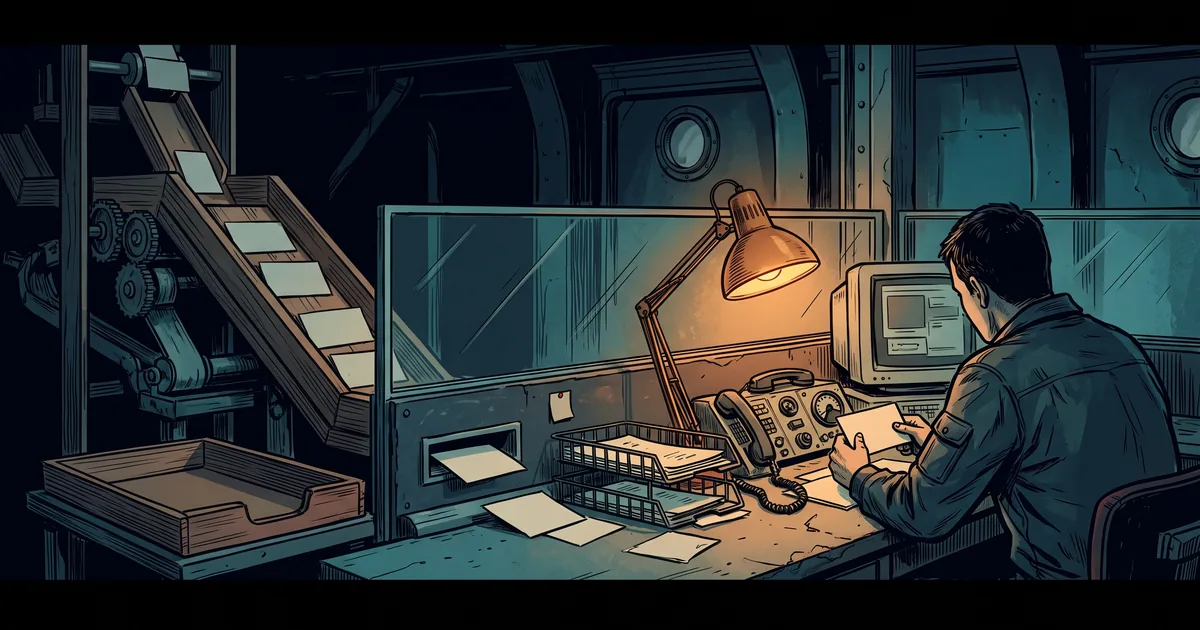
Autonomous marine navigation architectures expose critical vulnerabilities when algorithmic filters strip situational nuance before human supervisors intervene. An operational risk study published in the Proceedings of the Institution of Mechanical Engineers Part demonstrates that preserving supervisory context during human autonomy interaction is essential to prevent operational failures across control boundaries. When software layers compress rich vessel telemetry into static category labels, remote watchstanders lose qualitative environmental cues required to diagnose escalating anomalies. Complex industrial systems require explicit structural mechanisms that convey uncompressed situational telemetry across intake handoffs, ensuring supervisors retain clear operational visibility whenever autonomous routines encounter unforeseen environmental hazards or systemic anomalies.
Why do mismatches between agent appearance and behavior degrade operational trust?
Supervisory failure often traces back to behavioral dissonance between system interfaces and human cognitive models. Research in Frontiers in Psychology indicates that mismatches between agent appearance and actual computational behavior severely modulate human robot interaction, eroding operator confidence and degrading collaborative task performance. When an automated agent displays sophisticated humanlike communicative traits but executes mechanical or unresponsive actions during operational shifts, human partners experience cognitive confusion. In high stakes supervisory environments, this mismatch creates hesitation, prompting operators to second-guess valid system warnings or prematurely override stable automated tracks. Systems architectures must therefore align physical interface representations with actual computational capability, avoiding misleading cues that distort supervisory expectations during critical operational handoffs.
How can multi-criteria decision frameworks resolve operational trade-offs during intake arbitration?
Balancing automated filtering against deep contextual reporting requires rigorous multi-attribute evaluation rather than crude threshold filtering. Methodological research in the Journal of Business Economics and Management introduces the ARCAS group decision making approach, combining SWARA and ARAS techniques to structure negotiation criteria and resolve complex trade-offs among competing alternatives. When applied to computational intake pipelines, this multi-criteria framework allows engineering teams to weigh conflicting operational priorities, such as transmission bandwidth, parsing latency, and situational completeness. Instead of permanently discarding nuanced sensor telemetry at the ingestion boundary, systems can rank competing criteria systematically, routing critical raw signals to human specialists while routing routine updates through standard automated procedures to preserve downstream supervisory comprehension.
What command and control structures preserve continuous telemetry for robotic operators?
Robust supervisory architectures must maintain continuous communication channels across volatile physical domains. As of August 31, 2017, analysis of emergency robotics in InTech eBooks highlights that command and control systems for search and rescue operations depend heavily on explicit interface boundaries that deliver unbroken telemetry streams during dynamic missions. When field robots traverse unstructured, hazardous environments, human operators require uninterrupted perceptual feedback to steer actuators and calibrate mechanical responses accurately. If network boundaries truncate sensor streams to minimize communication overhead, operators experience sudden disengagement from spatial reality. System designers must construct modular dispatch layers that protect essential environmental signals, guaranteeing that human supervisors possess sufficient contextual awareness to intervene decisively before field anomalies transform into irrecoverable mission failures.
Sources
- Proceedings of the Institution of Mechanical Engineers Part : A risk model for autonomous marine systems and operation focusing on human–autonomy collaboration, 2017-08-01
- Frontiers in Psychology: You Look Human, But Act Like a Machine: Agent Appearance and Behavior Modulate Different Aspects of Human–Robot Interaction, 2017-08-23
- Journal of Business Economics and Management: NEW GROUP DECISION-MAKING ARCAS APPROACH BASED ON THE INTEGRATION OF THE SWARA AND THE ARAS METHODS ADAPTED FOR NEGOTIATIONS, 2017-08-27
- InTech eBooks: Command and Control Systems for Search and Rescue Robots, 2017-08-23


