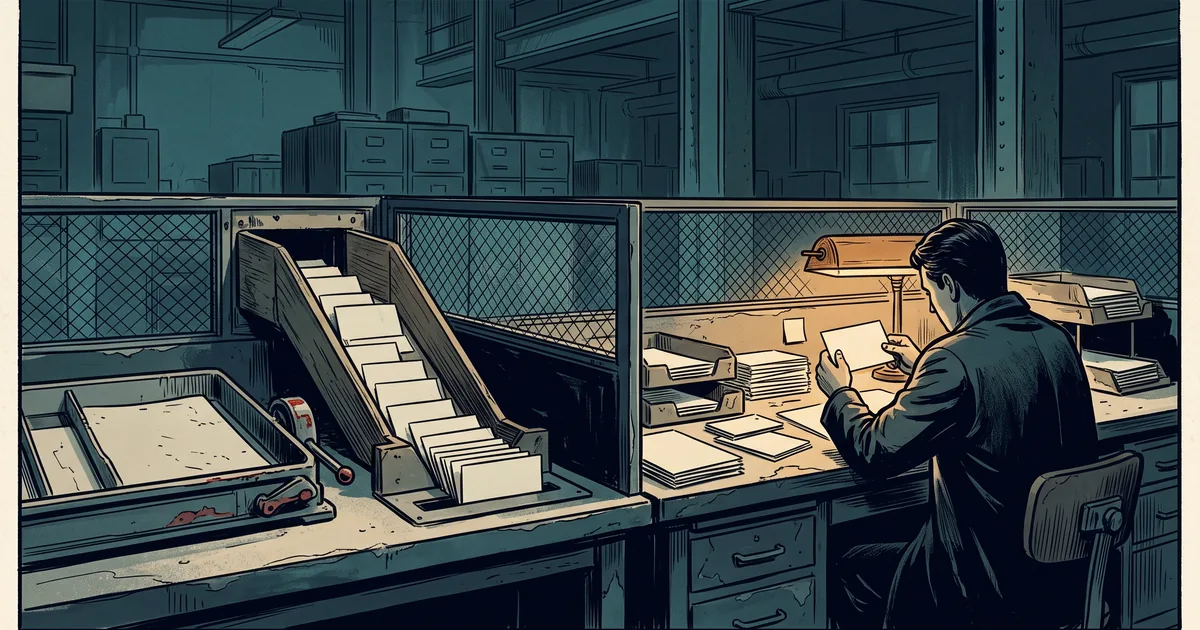
Formalizing the intake boundary between automated categorization and downstream human adjudication reveals a persistent structural failure. When system architects place rigid classification schemas at initial intake, essential peripheral facts disappear before senior evaluators inspect the file. Analysis of structured judicial protocols demonstrates that systematic decision-making requires preserving qualitative evidentiary context directly at the intake perimeter (University of Toronto Press). Stripping narrative nuances into rigid binary categories forces subsequent reviewers into expensive manual reconstruction. High-stakes adjudicative pipelines show that premature procedural reduction undermines consistency, as subsequent reviewers must speculate about lost evidentiary posture instead of working from complete primary records.
Why does early procedural filtering introduce severe adjudicative friction?
Empirical case examinations show that initial routing choices degrade rapidly when clerical intake schemas discard non-standard factual qualifiers. Detailed studies of institutional tribunals demonstrate that downstream adjudicators experience substantial coordination friction when case files lack early contextual detail (University of Toronto Press). When docketing clerks or automated triage forms compress nuanced claims into standardized taxonomy buckets, secondary adjudicators misjudge procedural urgency. Reconstructing dropped procedural context requires circular file transfers, extensive evidentiary rebriefing, and supplementary hearings. These disruptions demonstrate that procedural acceleration at the boundary creates systemic delays inside subsequent deliberation phases, proving that early filtering frequently introduces administrative gridlock rather than operational efficiency.
How does technology-centred design compromise human supervisory oversight?
Human factors research indicates that technology-centred automation isolates human supervisors from operational realities by automating initial filtering stages without human-centred fallback paths (Routledge). When an automated interface presents a sanitized summary instead of raw operational cues, supervisory operators lose the situational awareness required to detect edge-case anomalies. Technology-centred systems assume that downstream operators only require digested conclusions. In contrast, human-centred system architectures preserve original narrative signals alongside automated suggestions. By retaining primary contextual parameters throughout the handoff boundary, human supervisors can quickly detect false correlations, re-evaluate procedural classifications, and prevent silent upstream errors from propagating unchecked through downstream operational queues.
How do knowledge-based models resolve complex industrial intake handoffs?
Industrial scheduling and manufacturing architectures encounter identical boundary hazards when feeding dynamic operational tasks into algorithmic control units. Knowledge-based planning systems for industrial automation demonstrate that high-level planners require intact contextual parameters at ingress to generate valid downstream schedules (Springer International Publishing). Incomplete parameter transmission forces scheduling engines to compute plans using synthetic assumptions, yielding brittle schedules that collapse under physical disruptions. When operational parameters retain physical interdependencies at initial intake, industrial planners accurately anticipate execution bottlenecks. Across legal adjudication and industrial engineering, preserving comprehensive contextual provenance at system interfaces remains essential for resilient decision-making.
Sources
- University of Toronto Press: 6. Disciplined Judicial Decision-Making, 2018-12-31
- University of Toronto Press: 9. Judicial Decision-Making: A Case Study, 2018-12-31
- Routledge: Technology-centred and human-centred automation, 2018-12-20
- Springer International Publishing: Knowledge-Based Planning for Industrial Automation Systems: The Way to Support Decision Making, 2018-12-29


