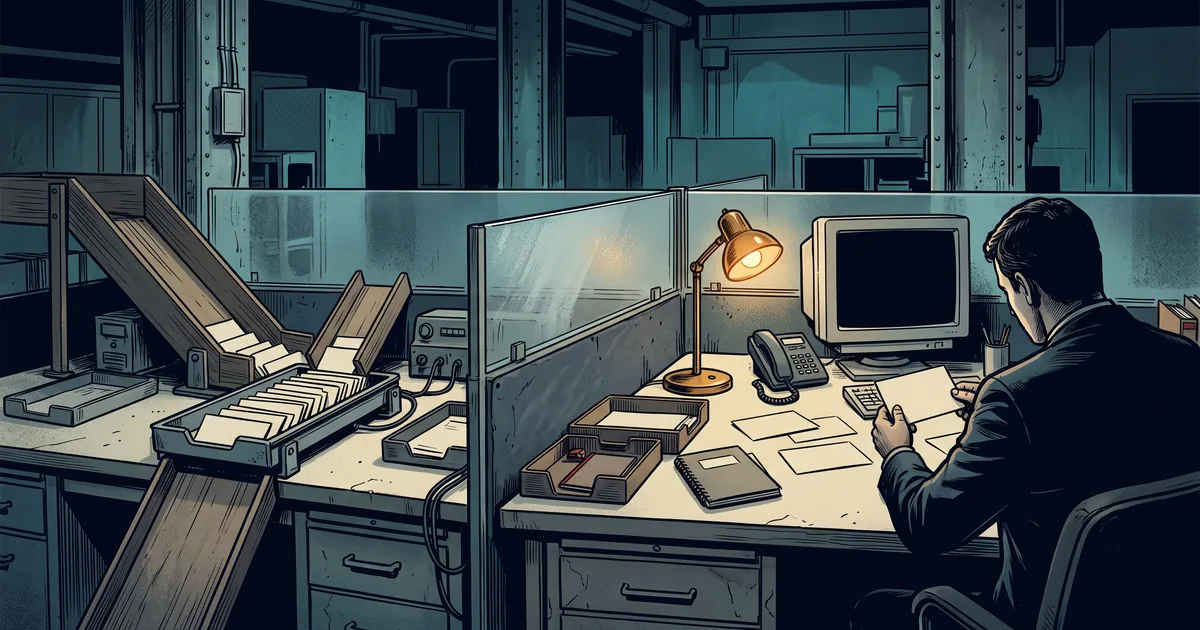
Decoupled automation architectures in networked industrial systems expose operational risks when remote control pipelines obscure raw machine states. Network boundaries that separate computation from local plant execution introduce critical gaps during manual intervention, as surveyed in IEEE Transactions on Automation Science and Engineering. Remote servers frequently execute trajectory calculations or dispatch heuristics offsite, sending back only high-level instructions or compressed telemetry. While this offloading reduces onboard processing weight, it blinds supervisory operators to emergent physical discrepancies. When transient communication drops or sensor drifts trigger unexpected failovers, human overseers inherit unstable industrial mechanisms without the contextual trend lines needed to re-establish safe real-time equilibrium.
Why does upstream telemetry pruning blind transportation supervisory dispatchers during handoffs?
contemporary transportation monitoring architectures rely heavily on centralized processing to balance moving fleets across broad geographical transit sectors. Research in Procedia Manufacturing indicates that reducing human supervisory visibility to filtered telemetry introduces critical latency during manual takeover and emergency intervention. Upstream network hubs often strip intermediate sensor updates to conserve shared bandwidth, passing along aggregated categorical flags instead of continuous physical readings. Dispatchers facing sudden vehicle disengagements receive discrete status warnings that mask earlier trajectory drift and velocity fluctuations. Without continuous parameter streams, supervisors must spend valuable seconds querying underlying telemetry registers to verify spatial safety margins before executing manual braking or track diversions.
How do automated decision aids compromise operator mental models during sudden disengagements?
Automated analytical layers intended to simplify monitoring often undermine human diagnostic readiness. Diagnostic studies published in DepositOnce demonstrate that automated decision aids that abstract intermediate sensor signals degrade human operators' mental models and slow anomaly verification during unexpected system disengagements. By packaging complex telemetry into simplified recommendations, automated advisors separate human controllers from the dynamic shifts occurring across the monitored equipment. Operators gradually rely on secondary recommendation summaries rather than maintaining an active cognitive model of baseline trends. When an unmodeled condition causes the automated software to abort its operational cycle, personnel struggle to locate which primary sensor readings invalidates the system state.
Can electric grid control rooms maintain situation awareness under aggressive alarm filtering?
High-voltage transmission systems present severe operational challenges when centralized alerting interfaces swallow vital subsystem cues. Field analysis in Procedia Manufacturing shows that aggressive alarm processing and telemetry filtering inhibit situation awareness by requiring operators to query raw data feeds to diagnose subsystem faults. Filtering routines eliminate minor fluctuations to prevent alert fatigue, yet those suppressed electrical transients frequently provide early warnings of impending transformer saturation. Operators stripped of progressive diagnostic context must manually cross-examine disparate bus telemetry while balancing volatile transmission loads. Effective supervisory infrastructure must preserve raw background telemetry histories, ensuring that human controllers can audit system states the instant automated protections trip.
Sources
- IEEE Transactions on Automation Science and Engineering: A Survey of Research on Cloud Robotics and Automation, 2015-01-12
- Procedia Manufacturing: Human Factors and Ergonomics in Transportation Control Systems, 2015-01-01
- DepositOnce: Human performance consequences of automated decision aids, 2015-01-01
- Procedia Manufacturing: Situation Awareness and Automation in the Electric Grid Control Room, 2015-01-01


